IT'S EASY TO GET STARTED! IN STUDIO & ONLINE PIANO INSTRUCTION FROM THE CURIOUS PIANIST!


Welcoming kids and adults of all ages for in studio, online, and hybrid piano lessons in the San Francisco Bay Area serving the local communities and school districts of Saratoga, Los Gatos, Los Gatos Mountains, Monte Sereno, Cupertino, Westmont, Campbell, West San Jose, San Jose, Sunnyvale, Palo Alto, Los Altos, Cambrian Park, Santa Clara, Mountain View and for remote and online students everywhere! Traditional private instruction will be tailored to your student using with modern techniques and methods! For online or hybrid students, an immersive multi-camera approach provides engaging and fun remote lessons! Homeschoolers welcome!
Contact me for a "get acquainted" meeting/lesson! 🍎 🎹 🎶
Deborah's Piano Lessons
Private Piano Instruction with Deborah Savage
TAKE LESSONS IN PERSON, ONLINE, OR A COMBINATION OF BOTH! FOR THOSE WHO PREFER, LEARN VIRTUALLY FROM THE COMFORT AND CONVENIENCE OF YOUR OWN HOME
For non-local students in the domestic US or beyond, remote instruction is also available to accommodate your time zone!
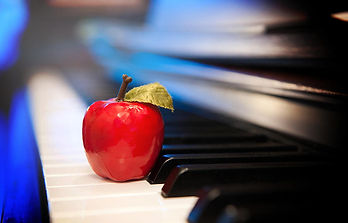
School Days, School Days!
It's a great time to set some musical goals for the new year! What do you want to accomplish?
🍎 🎹 HAPPY SEPTEMBER! 🎹 🍎
🤔 🎹 FIRST YEAR - WHAT TO EXPECT? 🤔 🎹
FIRST YEAR OF PIANO FOR THE YOUNG STUDENT - MILESTONES
The first year of piano for the young student is all about learning the fundamentals of a new language - all the senses are engaged - eyes, ears, the body, positions and postures of the hands, fingers, arms, and overall body positions, and body postures, as well as developing and building awareness of pitch, rhythm, musicality, and the symbology and encoding of the musical language.
Skills and concepts are taught in a order to build good habits and to make learning and building on previous concepts easy and natural.
Here is a typical layout of what a student might learn in the first year.
Month 1-2: Introduction & Fundamental Concepts
-
Milestones:
-
Piano Posture & Hand Position: Understanding proper sitting posture, hand shape, and finger numbers.
-
Exploring the Piano: Familiarizing with the entire keyboard, playing high and low sounds, and identifying the black and white keys.
-
Rote Pieces: Learning simple rote pieces to build confidence in playing without reading music.
-
Rhythm & Pulse: Clapping and playing basic rhythmic patterns (e.g., quarter notes, half notes).
-
Aural Skills: Developing listening skills through echoing teacher’s rhythms and melodies.
-
Month 3-4: Developing Basic Technique
-
Milestones:
-
Technique: Introducing basic technical exercises, including arm drops and finger independence.
-
Reading Skills: Beginning to recognize and play simple notes on the staff (starting with middle C position).
-
Rote Pieces: Expanding the repertoire of rote pieces, adding variety in dynamics and articulation.
-
Creativity & Improvisation: Encouraging creativity through simple improvisation exercises based on pentatonic scales.
-
Month 5-6: Early Reading & Coordination
-
Milestones:
-
Note Reading: Progressing from recognizing individual notes to reading short pieces using landmark notes and intervals.
-
Two-Hand Coordination: Playing simple pieces that require coordination between the hands.
-
Rhythm Patterns: Introducing dotted rhythms and rests.
-
Listening & Memory: Developing memorization skills by recalling and playing previously learned rote pieces.
-
Month 7-8: Expanding Repertoire & Musicality
-
Milestones:
-
Repertoire Expansion: Learning slightly more complex rote and reading pieces, focusing on phrasing and expression.
-
Dynamic Control: Understanding and applying dynamics such as forte and piano.
-
Technical Development: Introducing more complex technical exercises, such as scales in simple patterns.
-
Duets & Ensemble: Starting to play duets with the teacher or other students to build ensemble skills.
-
Month 9-10: Building Fluency
-
Milestones:
-
Fluency in Reading: Reading and playing pieces with a variety of rhythmic patterns and note values.
-
Expression: Emphasizing musicality and expression, focusing on articulation and phrasing.
-
Repertoire Mastery: Polishing and performing learned pieces with confidence.
-
Improvisation: Developing more sophisticated improvisations, incorporating learned rhythms and motifs.
-
Month 11-12: Consolidation & Performance
-
Milestones:
-
Review & Consolidation: Reviewing and reinforcing concepts learned throughout the year.
-
Performance Preparation: Preparing for a recital or informal performance, focusing on stage presence and confidence.
-
Sight Reading: Improving sight-reading skills through regular practice of new, simple pieces.
-
Reflect & Set Goals: Reflecting on the progress made and setting goals for the next year.
-